
COURSE SEVENTEEN - The Social and Political Life of Dreams
EXTENSION PROGRAM
Online Course
Course Coordinators and Leaders: Sharon Sliwinski PhD, and Chris Vanderwees, PhD, RP
Thursday, 7:30 pm – 9:30 pm: May 6, 13, 20, 27, 2027 (4 sessions)
Fees: $300
Deadline for registration is April 30, 2027.
Preregistration is required.
** DISTANCE PARTICIPATION ONLY – This course will be conducted online.
This course examines the social and political life of dreams. We begin with Sigmund Freud’s (1900) insight that, at bottom, dreams are simply “a particular form of thinking made possible by the conditions of the state of sleep.” Our course takes this insight as a central pivot to explore how dreaming—and especially the dream’s “work”—might help us better grasp the dreamer’s sociogenic conditions. In our course dreams are understood as a crucial psychological event that is central to health and wellbeing and as a radical form of thinking that carries important transpersonal information, revealing the ways social, historical, and environmental forces concentrate on an individual’s experience of life.
Week 1: Freud’s Evolving Dream Theory
In The Interpretation of Dreams (1900), Sigmund Freud announced his signal theory: dreams represent the disguised fulfillment of unconscious wishes. He unwaveringly defended this thesis until confronted with the nightmares of traumatized soldiers returning from the battlefields of WWI. In response to the pitched political debate about these soldiers’ symptoms, Freud revised his thinking, eventually conceptualizing his second, structural model, which included a critical shift in his understanding of psychic functioning. Traumatic dreams, Freud proposed, function “beyond the pleasure principle.”
- excerpts from Sigmund Freud’s, On Dreams (1901) and Beyond the Pleasure Principle (1920)
- excerpts from William Rivers, Conflict and Dream (1923)
Week 2: A turn toward manifest content & The Third Reich of Dreams
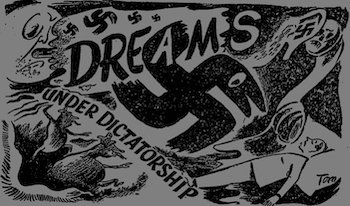
The Berlin journalist, Charlotte Beradt, began having unsettling dreams after Adolf Hitler took power in 1933. She envisioned herself being shot at, tortured and scalped, surrounded by Nazis in disguise, and breathlessly fleeing across fields with storm troopers at her heels. She began secretly collecting dreams from her friends and neighbors, and with the help of Hannah Arendt, the collection was published in the 1960s as The Third Reich of Dreams.
- Charlotte Beradt, The Third Reich of Dreams: The Nightmares of a Nation
- Reinhardt Koselleck, “Afterword to Charlotte Beradt’s The Third Reich of Dreams,” in The Practice of Conceptual History (1981)
- Erik Homburger Erikson, “The Dream Specimen of Psychoanalysis” Journal of the American Psychoanalytic Association Vol 2 issue 1 (1954): 5-56
Week 3: Frantz Fanon and sociogenic principle
Beginning in the 1950s, the radical psychiatrist Frantz Fanon began calling attention to the colonial dimensions of the clinical setting. He reframed the work of healing as a social task—one which necessarily involved decolonizing the society in which his patients lived. Throughout several works, Fanon drew attention to the manifest content of dreams as providing evidence of the dreamer’s “sociogenetic” conditions.
- excerpts from Frantz Fanon’s Black Skin White Masks (1953) and Wretched of the Earth (1963)
- excerpts from Derek Hook, Fanon, Psychoanalysis, and Critical Decolonial Psychology
- Sylvia Wynter, Towards the Sociogenetic Principle: Fanon, Identity, the Puzzle of Conscious Experience, and What It Is Like to Be ‘Black’” (1999)
Week 4: Dreamers of the 21st Century
Our last week is given over to contemporary strategies for attending dream life as an innovative means to grasp complex social and political situations. Dreams speak volumes about the worlds we inhabit. Attending to dream life can help make legible social information that has not yet become knowledge in rational or empirical terms.
- excerpts from Sharon Sliwinski, Dreaming in Dark Times (2017) and An Alphabet for Dreamers: How to See the World with Eyes Closed (2025)
- Magnus Wennman, Fatima’s Drawings (2016), 5:35 mins. https://vimeo.com/159034152
- Magdalena Zolkos, “Oneiric Witnessing: Dreamscapes of War,” Humanities 4, no. 2: 29 (2025) https://doi.org/10.3390/h14020029
Learning Objectives:
By the end of the course, participants will be able to:
- Gain familiarity with clinical dream theory;
- Develop an understanding of how dream life is impacted by social and political dimensions;
- Gain familiarity with new, interdisciplinary approaches to understanding and working with dream material.
Sharon Sliwinski, PhD
Sharon Sliwinski, PhD, is professor of Information & Media Studies at Western University. Her interdisciplinary research works across visual studies, political theory, cultural history, and psychosocial studies. She has written extensively about photography and human rights. In 2017, she established the Museum of Dreams, a research hub and public memory studio dedicated to exploring the social and political significance of dream life. Together with a wide range of partners, the Museum collaboratively produces exhibitions, essays, research reports, and a podcast series. We also gather original dream material through a community partnership project called Dreamers of the 21st Century. Her most recent book is An Alphabet for Dreamers: How to See the World With Eyes Closed (MIT Press, 2025)
Chris Vanderwees, PhD, RP
Chris Vanderwees, PhD, RP, is a psychoanalyst, registered psychotherapist, and clinical supervisor who works within the community at St. John the Compassionate Mission in Toronto. He has written widely on communications, critical theory, philosophy, and psychoanalysis. His most recent book is On the Theory and Clinic of Lacanian Psychoanalysis: Speaking of Lacan (Routledge, 2026). He is an Affiliate of the TPS&I.
This event is eligible for Section 1 CME credits (0.5 credits/hour). This event is an accredited group learning activity (section 1) as defined by the Maintenance of Certificate Program of the Royal College of Physicians and Surgeons of Canada, approved by the Canadian Psychiatric Association (CPA). The specific opinions and content of this event are not necessarily those of the CPA, and are the responsibility of the organizer(s) alone. As per the Royal College standard, each presentation provides a minimum of 25% interactive learning.
Full-time students in universities and colleges, and full-time mental-health trainees are eligible for a 25% reduction in course fees. Proof of 2026/2027 status needs to be provided. Please contact the tps&i directly to register at a discount.
Refunds must be requested in writing two weeks prior to the beginning of a course. A handling fee of $50 will be retained. After these two weeks, fees cannot be returned.
For more information about and for registration in the tps&i Extension Programs, Scientific Meetings, Training Programs, Study and Supervision groups and Special Presentations, please visit our website: torontopsychoanalysis.com or email info@torontopsychoanalysis.com