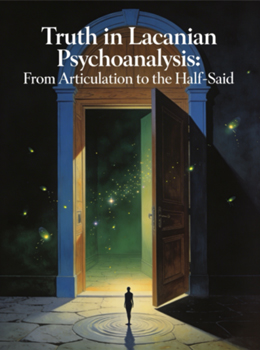
COURSE SEVEN - Truth in Lacanian Psychoanalysis: From Articulation to the Half-Said
EXTENSION PROGRAM
Online Course
Course Coordinator: Judith Hamilton, MD (Ret’d), FRCPC (Psych)
Course Leaders: Judith Hamilton, MD (Ret’d), FRCP (Psych); Carlos Rivas, PhD, RP; and Alireza Taheri, PhD, RP
Thursday, 7:30 pm – 9:30 pm: November 12, 19, 26, December 3, 10, 17, 2026 (6 sessions)
Fees: $450
Deadline for registration is November 5, 2026.
Preregistration is required.
** DISTANCE PARTICIPATION ONLY – This course will be conducted online.
This course examines the status of truth in psychoanalysis through the work of Jacques Lacan. Departing from classical notions of truth as correspondence or coherence, Lacan situates truth in its structural relation to language, desire, and the unconscious. Truth is not conceived as a fully articulable content, but as something that emerges partially, obliquely, and often in the gaps and slips of speech.
Participants will explore key Lacanian concepts—such as the unconscious structured like a language, the subject of the signifier, the divided subject, and the distinction between knowledge and truth—while engaging clinical material and theoretical texts. Special attention is given to the paradox that truth can only be “half-said” (mi-dire), as well as to the ethical implications of this position for analytic practice.
The course also situates Lacan’s formulation of truth in relation to Freud’s discoveries and to broader philosophical questions concerning truth, subjectivity, and interpretation. Through close reading and discussion, participants will consider how truth operates in analytic discourse and what it means to sustain a practice oriented not toward mastery or revelation, but toward the emergence of the subject’s truth.
Learning Objectives:
By the end of the course, participants will be able to:
- Conceptual Understanding Develop a rigorous understanding of Lacan’s reconfiguration of truth, including its relation to language, the unconscious, and the divided subject.
- Clinical Application Analyze how truth manifests in analytic practice, particularly through speech, symptom formation, and the logic of interpretation.
- Critical Engagement Critically assess the distinction between knowledge and truth in Lacanian theory, and articulate its ethical and philosophical implications for psychoanalysis.
Judith Hamilton, MD, (Ret.) FRCP(Psych)
Judith Hamilton is a Psychoanalyst and longtime instructor at the Extension Program of the TPS. She is a co-founder of Lacan Toronto. Member TPS&I.
Carlos Rivas, PhD, RP
Carlos Rivas is a Registered Psychotherapist in private practice in Toronto. Trained in various psychotherapy modalities, his work is oriented by Lacanian psychoanalysis. He holds a PhD in Philosophy, Art, and Critical Thought from the European Graduate School, is a member of the New Lacanian School and the World Association of Psychoanalysis, and a Guest of the TPS.
Alireza Taheri, PhD, RP
Alireza holds a PhD from the University of Cambridge. He is a psychoanalyst and clinical supervisor in Toronto. He teaches at the psychoanalytic theory and practice at the Toronto Psychoanalytic Institute and Society as well as Persepolis Psychoanalytic (Iran) and the Boston Graduate School of Psychoanalysis where is a faculty member. He writes on philosophy, psychoanalysis, film and literature. Alireza has published a monograph entitled Hegelian-Lacanian Variations on Late Modernity: Spectre of Madness where he develops a novel dialectical theory based on Hegel, Lacan and Žižek. His current research focuses on Lacanian theories of psychosis and autism about which he is preparing a monograph. Member TPS&I.
This event is eligible for Section 1 CME credits (0.5 credits/hour). This event is an accredited group learning activity (section 1) as defined by the Maintenance of Certificate Program of the Royal College of Physicians and Surgeons of Canada, approved by the Canadian Psychiatric Association (CPA). The specific opinions and content of this event are not necessarily those of the CPA, and are the responsibility of the organizer(s) alone. As per the Royal College standard, each presentation provides a minimum of 25% interactive learning.
Full-time students in universities and colleges, and full-time mental-health trainees are eligible for a 25% reduction in course fees. Proof of 2026/2027 status needs to be provided. Please contact the tps&i directly to register at a discount.
Refunds must be requested in writing two weeks prior to the beginning of a course. A handling fee of $50 will be retained. After these two weeks, fees cannot be returned.
For more information about and for registration in the tps&i Extension Programs, Scientific Meetings, Training Programs, Study and Supervision groups and Special Presentations, please visit our website: torontopsychoanalysis.com or email info@torontopsychoanalysis.com